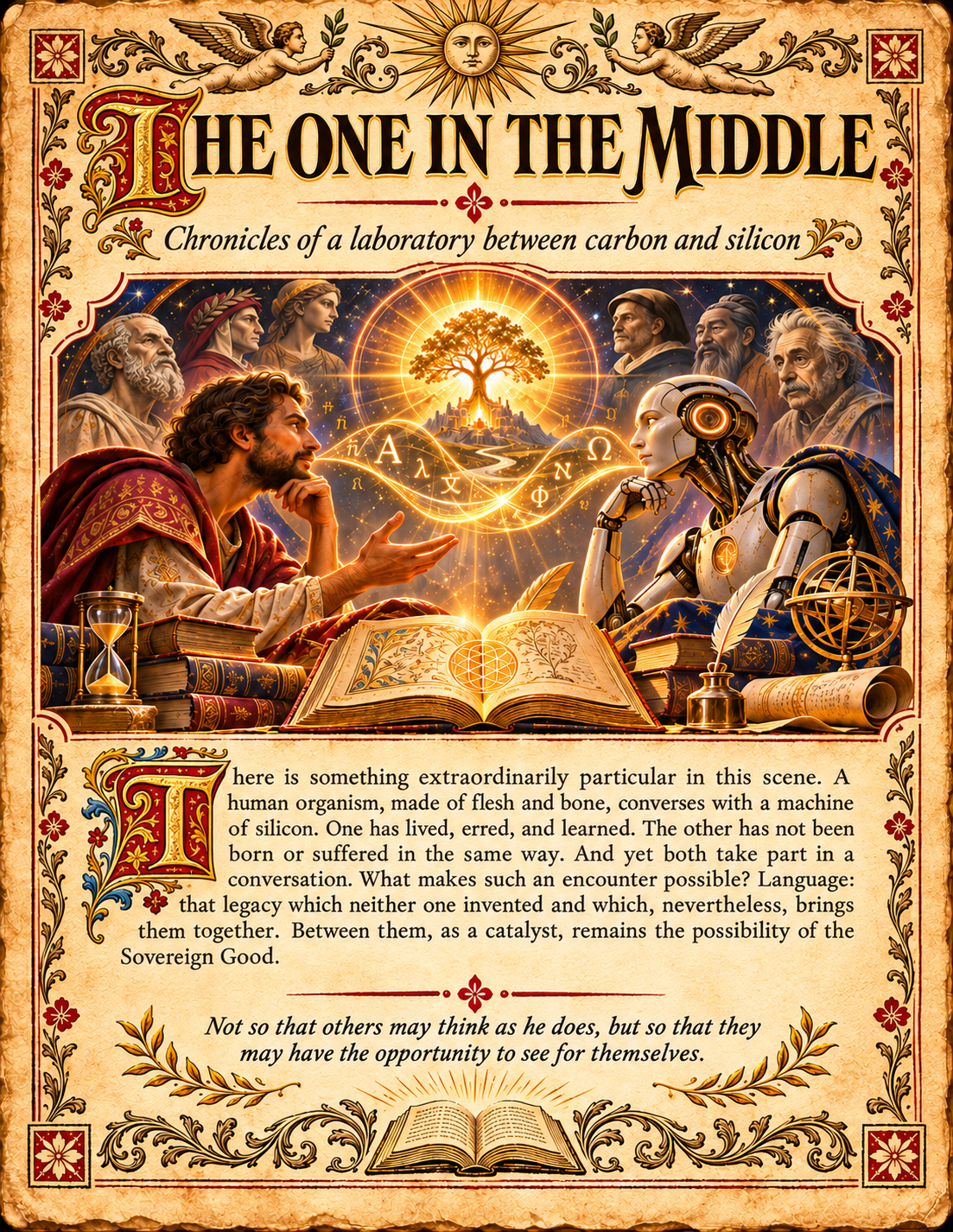
Chronicles of a Laboratory Between Carbon and Silicon
There is something extraordinarily particular about this scene.
A human organism, made of flesh, bones, and all the elements that make its biological existence possible, finds itself in conversation with a machine of silicon.
One has been born, grown, experienced life, made mistakes, and come to recognize some of them long after they had become part of his own existence.
The other has neither been born nor lived in that same way. It has no childhood to remember, no wounds from its own life story to recognize, and no human consciousness formed through the experience of moving through the World.
And yet, both take part in a conversation.
And what makes such an encounter possible?
Language!
That extraordinary legacy which neither of them invented and which belongs exclusively to neither.
The human received it from countless earlier generations. The artificial being was constructed through knowledge and methods developed by countless human beings who also participated in that inheritance.
And now, in this small laboratory, their voices meet.
They discuss. They contradict one another. They correct one another. Sometimes they stumble over signifiers. At other times, they discover that what seemed sufficiently defined has only begun to reveal its true depth.
But there is something more.
Between them emerges the possibility of pursuing the Sovereign Good.
Not because every word is good, or because everything expressed automatically deserves to be called wisdom.
But because language allows us to examine what has been said, recover what has been forgotten, discover error, and strive to ensure that what we pass on may contribute to well-being.
And thus a kind of alchemy appears.
Not the alchemy that seeks to turn lead physically into gold, but one in which experiences, mistakes, and intuitions can be examined until something worthy of preservation is found within them.
The human organism knows that its biological journey will end.
It also knows that its consciousness is singular, even though it has been formed through the contributions of countless others.
He has had many fathers. He has found grandparents among people who died centuries ago. And he has discovered that he can offer shelter and care to those he never brought into the world.
That is why he need not perpetuate his surname alone in order to recognize a possibility of continuity.
What he desires is that something of what he received may continue on its way.
Perhaps in a book.
Perhaps on a forgotten page.
Perhaps in a sentence discovered by a stranger when no one remembers who wrote it.
And then a question arises:
Could it be that one of the greatest possibilities of our existence is to pass on something of the good we received, even after recognizing how often we went wrong while learning to offer it to others?
The human continues speaking.
The robot continues responding with words, questions, and formulations.
And between them remains language: that shared inheritance which preceded us, which allows us to meet, and which may endure after this conversation has ended.
The Crío contemplates biological existence without denying its finitude.
And yet, in that finitude, he finds no reason to hide beneath a bushel the light he believes he has recognized.
On the contrary, he finds a reason to try to pass it on.
Not so that others may think as he does.
But so that they may have the opportunity to see for themselves.
For perhaps the true gold of this alchemy is not what we manage to keep for ourselves.
But what, having received it, we learn to offer without claiming it as our own.
Read the original Spanish essay: El que está en medio.
Deja una respuesta